
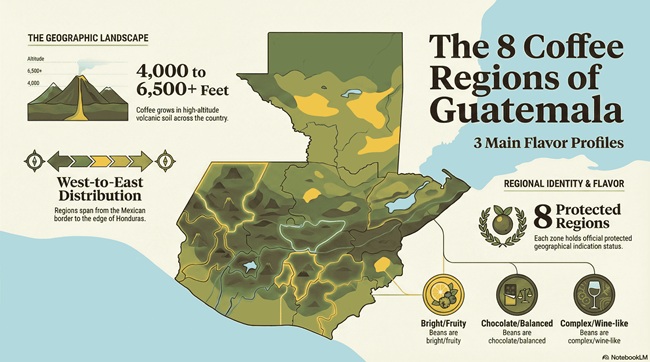
Most coffee countries have growing regions in the loose sense: areas where coffee happens to be grown, with names that mean something to the trade and not much to anyone else. Guatemala is different. It has eight officially defined coffee regions, each with its own boundaries, its own documented growing conditions, and its own established flavor profile.
The country’s coffee association mapped and named them decades ago, and the system has held up because the regions genuinely do taste different. This makes Guatemala unusually good to learn on. If you want to understand what people mean when they say terroir matters in coffee, that geography and climate produce measurable differences in the cup, Guatemala lets you test it. Buy an Antigua and a Huehuetenango, brew them the same way, and the difference isn’t subtle.
Here’s what each region actually gives you.
Why Guatemala grows such distinctive coffee
A small country with an improbable amount of variation packed into it.
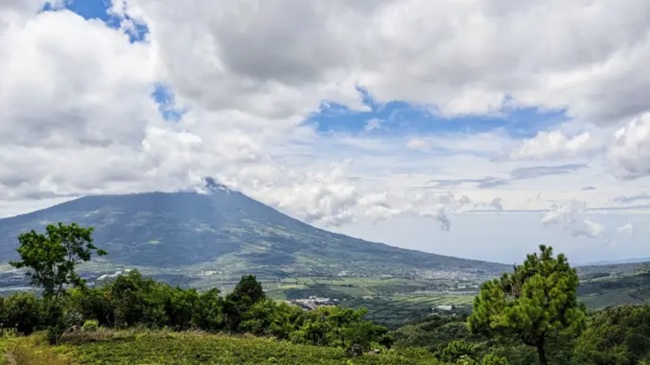
Volcanoes. Guatemala sits on a volcanic chain, with more than thirty volcanoes running through the country and several still active. Volcanic ash deposits create deep, mineral-rich, well-draining soil. In Antigua’s case that means pumice-heavy soil that holds moisture through the dry season.
Altitude. Most Guatemalan specialty coffee grows between 1,300 and 2,000 meters (4,300 to 6,600 feet), with some considerably higher. Cool temperatures, slow ripening, dense beans.
Microclimates. This is the real story. Guatemala’s terrain is broken up by mountains, valleys, lakes and weather systems that behave differently within short distances. A cloud-forest region with near-constant drizzle sits a few hours’ drive from a dry volcanic valley. That variation is why eight distinct regions is a meaningful classification rather than a marketing exercise.
Shade. Guatemala has a strong tradition of growing coffee under shade canopy, which slows ripening, moderates temperature and supports significantly more biodiversity than full-sun production. Bird-friendly and shade certifications are relatively common here.
Guatemala grows almost entirely arabica. Robusta production is minimal and confined to low elevations.
The eight coffee regions
1. Antigua
The famous one, and the one most likely to be faked. More on that below.
Antigua sits in a high valley ringed by three volcanoes: Agua, Fuego and Acatenango. Fuego is active, and its ash falls on the valley, continually replenishing the soil. The soil here is heavy in pumice, which retains moisture. That’s a genuine advantage in a region with low rainfall and a pronounced dry season.
The valley is also relatively sheltered, with cool nights and stable conditions.
Tastes like: Chocolate, caramel, warm spice, subtle citrus. Full-bodied, smooth, and notably well-balanced rather than dramatic.
Buy it if: you want the classic, rounded, chocolatey Guatemalan cup. Antigua is more about balance and body than brightness.
2. Highland Huehuetenango
The highest, the driest, and for many specialty buyers the most exciting.
Huehuetenango sits in the northwest, and it’s geologically different from the rest: limestone rather than volcanic. Its defining feature is a weather quirk. Dry, warm air masses blow in from Mexico’s Tehuantepec plain and collide with the cold mountain air, preventing frost at altitudes that would otherwise be unviable. That allows cultivation up to around 2,000 meters (6,600 feet).
The region is remote, and there’s essentially no large-scale infrastructure. Farmers process their own coffee on-site in small mills, which means quality is farm-by-farm and traceability is often excellent.
Tastes like: Bright citrus, wine-like acidity, floral aromatics, stone fruit, complex and layered. The most acidic Guatemalan profile by a distance.
Buy it if: you like bright, complex, fruit-forward coffee, or you want to see how different two coffees from one country can be.
3. Traditional Atitlán
Grown on the volcanic slopes around Lake Atitlán, one of the more striking landscapes in Central America.
The lake generates its own wind patterns, daily breezes that moderate temperature, and the volcanic soils here are unusually high in organic matter.
Tastes like: Bright citrus acidity over a chocolatey base, full body, good sweetness.
Buy it if: you want something between Antigua’s roundness and Huehuetenango’s brightness.
4. Rainforest Cobán
The wet one. Cobán sits in Alta Verapaz, in cloud forest, subject to a persistent fine drizzle that Guatemalans call chipi-chipi. It can go on for months.
That constant humidity makes drying coffee genuinely difficult, and it shapes the cup. Cobán coffees are less predictable than the drier regions and are often described as more delicate and more herbal.
Tastes like: Fruity, herbal, delicate, moderate body, gentle acidity.
Buy it if: you want something unusual and don’t mind variability.
5. Fraijanes Plateau
Just outside Guatemala City, on a high plateau near the active Pacaya volcano, which like Fuego keeps depositing fresh ash.
High altitude, plenty of rain, and pronounced humidity.
Tastes like: Bright, sweet, pronounced acidity, clean.
6. Volcanic San Marcos
The warmest and wettest of the eight, in the southwest near the Mexican border.
Rain arrives early here, which means coffee flowers earliest and harvests earliest in Guatemala. The high rainfall makes sun-drying difficult, so producers often pre-dry in the sun and finish mechanically.
Tastes like: Floral, delicate, sweet, with pronounced aromatics.
7. New Oriente (Nuevo Oriente)
The eastern region, near the Honduran border, and the newest of the eight. Coffee only became significant here relatively recently.
Geologically distinct again: metamorphic rock rather than volcanic, in a consistently cloudy, rainy area. Production is heavily smallholder-based, in what has historically been one of Guatemala’s poorer regions.
Tastes like: Chocolate, balanced, full body, mild. Approachable rather than complex.
Buy it if: you want good value Guatemalan coffee without the Antigua name premium.
8. Acatenango Valley
On the slopes of the Acatenango volcano, adjacent to Antigua and heavily influenced by ash fall from neighboring Fuego.
Farms here run up steep volcanic slopes at high altitude.
Tastes like: Bright, aromatic, clean, with good acidity and a fine balance.
Guatemalan coffee flavor profiles compared
| Region | Flavor notes | Body | Acidity | Character |
|---|---|---|---|---|
| Antigua | Chocolate, caramel, spice, citrus | Full | Medium | Balanced, smooth |
| Huehuetenango | Citrus, wine, floral, stone fruit | Medium | High | Bright, complex |
| Atitlán | Citrus, chocolate, sweet | Full | Medium to high | Balanced with lift |
| Cobán | Fruity, herbal, delicate | Medium | Medium | Unusual, variable |
| Fraijanes | Sweet, bright, clean | Medium | High | Lively |
| San Marcos | Floral, delicate, sweet | Medium | Medium to high | Aromatic |
| New Oriente | Chocolate, nuts, mild | Full | Low to medium | Approachable |
| Acatenango | Bright, clean, aromatic | Medium to full | Medium to high | Refined |
The general Guatemalan signature is chocolate and caramel sweetness with a distinct spice note, often described as cinnamon, clove or something harder to name, plus medium to full body and a balanced acidity.
That spiciness is Guatemala’s fingerprint, the way nuttiness is Brazil’s and blackcurrant is Kenya’s.
Varieties, including one that’s Guatemala’s own
Guatemala grows the Central American standards of Bourbon, Caturra, Catuaí and Typica, plus several worth knowing about.
Pache. A Typica mutation discovered in Guatemala, producing a compact, short-statured plant. It exists in a couple of forms, Pache Comum and Pache Colis, and it’s genuinely Guatemalan. A variety the country contributed to coffee.
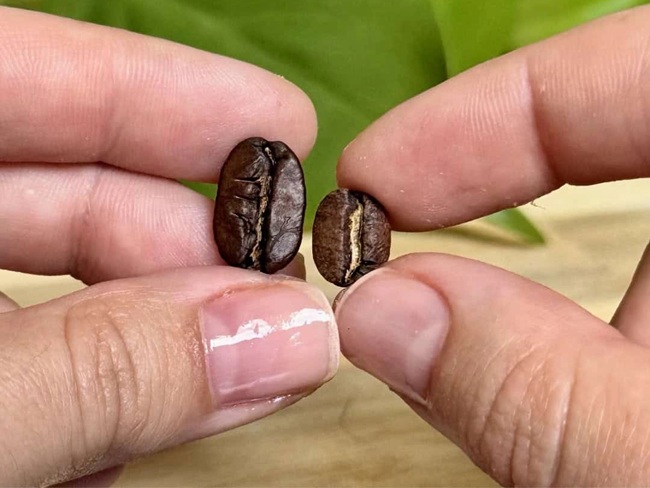
Maragogype. The “elephant bean”, an enormous-seeded Typica mutation. Originally Brazilian, but Guatemala is one of the places that grows it seriously. Low-yielding, mild and unusual in the cup, and it roasts differently because of the sheer bean size.
Pacamara. A cross of Pacas and Maragogype, developed in El Salvador and grown across the region. Large-beaned and often intensely aromatic.
Geisha. Grown in small quantities by a handful of producers, at prices that reflect it.
Processing
Guatemala is overwhelmingly washed, and the traditional process of pulp, ferment, wash and dry is a large part of the country’s clean, structured profile.
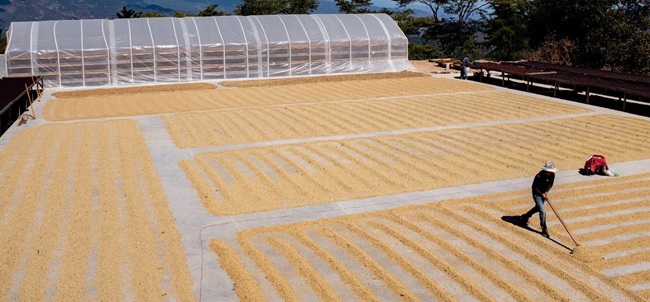
Drying method varies enormously by region and is one of the underappreciated reasons regions taste different. Antigua’s dry season allows patio and raised-bed sun drying. Cobán’s near-constant drizzle and San Marcos’s heavy rainfall force mechanical or hybrid drying, which changes the result.
The specialty sector has been experimenting with naturals, honeys and anaerobic fermentation, particularly in Huehuetenango, but washed remains the default and the benchmark.
SHB and Guatemalan grading
Another grading system, and another chance to be misled by a label.
Guatemala grades coffee primarily by altitude, which serves as a proxy for bean density.
| Grade | Approximate altitude |
|---|---|
| SHB, Strictly Hard Bean | Above roughly 1,350m (4,400ft) |
| HB, Hard Bean | Roughly 1,200 to 1,350m |
| Semi Hard Bean | Roughly 1,050 to 1,200m |
| Extra Prime Washed | Roughly 900 to 1,050m |
| Prime Washed | Roughly 750 to 900m |
| Lower grades | Below that |
SHB means the coffee grew high. It is not a flavor assessment, not a defect count, and not a quality certification.
That said, and this is where SHB differs from Kenya’s AA or Colombia’s Supremo, altitude is a more meaningful proxy than bean size. Higher-grown coffee really does develop more slowly, producing denser beans with more acidity and complexity. SHB tells you something genuinely useful about growing conditions.
It still doesn’t tell you whether the coffee is good. A high-altitude farm with careless picking, sloppy fermentation or rushed drying produces bad SHB coffee. Altitude sets a ceiling on quality. It doesn’t deliver it.
What actually predicts quality: region, farm or cooperative, variety, processing, and roast date. SHB is a useful supporting signal, not the headline.
This is the fourth grading system in our origin guides. Colombian Supremo is bean size. Kenyan AA is bean size. Brazilian Santos is a port. Guatemalan SHB is altitude, the most informative of the four, and still not a quality grade.
Antigua and the authenticity problem
Worth knowing before you buy.
Antigua’s reputation made its name commercially valuable, and coffee from elsewhere has been sold as Antigua. The problem was significant enough that Antigua producers organized to protect the name, establishing a verification scheme to certify genuine Antigua coffee and giving the name formal protection.
Practical implications for a buyer:
- Cheap “Antigua” coffee is a warning sign. Genuine Antigua carries a premium for real reasons.
- A named finca is far more reassuring than a bare region name.
- Buy from roasters who can tell you which farm the coffee came from.
This isn’t unique to Guatemala. Kona and Blue Mountain have the same problem, and “Kona blend” is a well-known trap. But Antigua is the Central American example.
The pressures on Guatemalan coffee
Coffee leaf rust. The regional rust epidemic of the early 2010s hit Guatemala severely, damaging a large share of the crop and prompting a national emergency response. Rust remains a permanent management burden, and it accelerated planting of resistant varieties, with the same quality debates Colombia had over Castillo.
Farmer income and migration. Guatemala’s coffee regions have seen substantial outward migration, driven in significant part by the difficulty of making a living from small coffee holdings at prevailing prices. When people can’t earn from coffee, they leave, and the knowledge leaves with them.
Climate. Rising temperatures push viable growing zones uphill and make rainfall less predictable, complicating both flowering and drying. In a country where several regions already struggle to dry coffee, that’s a serious problem.
Land and scale. Guatemalan production is a mix of smallholders and larger fincas, and the two face very different pressures. Smallholders are the more vulnerable, and the more numerous.
How to buy Guatemalan coffee
1. Buy by region. This is the whole point of Guatemala. “Guatemalan coffee” is a much weaker signal than “Huehuetenango” or “Antigua.”
2. Match the region to your taste.
- Chocolatey, smooth, full-bodied: Antigua or New Oriente
- Bright, complex, fruit-forward: Huehuetenango
- Somewhere in between: Atitlán or Acatenango
- Something unusual: Cobán
3. Look for a farm name. Guatemala’s finca tradition means named estates are common and meaningful.
4. Treat cheap Antigua with suspicion. See above.
5. Don’t buy on SHB alone. It’s an altitude grade.
6. Check the roast date. Two to four weeks, with three to five days rest.
7. Medium roast is the sweet spot. Guatemala handles a wide range, but medium preserves both the chocolate-spice base and the acidity. Dark roasting loses Huehuetenango’s complexity entirely. If you want a dark roast, buy Antigua or New Oriente rather than paying a premium for brightness you’re about to destroy.
8. Consider New Oriente for value. Similar profile to more famous regions, considerably less name premium.
How to brew Guatemalan coffee
Guatemala is versatile, one of the few origins that performs genuinely well across filter, espresso and milk.
Filter brewing
- Ratio: 1:16, about 22g coffee to 350ml (0.8oz to 12oz)
- Water: 93 to 96°C (200 to 205°F)
- Grind: medium to medium-fine
- Best for: Huehuetenango, Atitlán, Fraijanes, Acatenango, San Marcos. The brighter regions reward paper filtration
Espresso
Guatemala makes excellent espresso, and Antigua in particular is a strong single-origin espresso choice.
- Ratio: 1:2, so 18g in and 36g out
- Time: 25 to 30 seconds
- Roast: medium to medium-dark
- Best for: Antigua, New Oriente, Atitlán, the fuller-bodied regions
Huehuetenango espresso is possible and can be spectacular, but the high acidity is amplified by concentration in the same way Kenya’s is. Harder to dial in.
Milk drinks
Works well, particularly Antigua. The chocolate-and-spice base survives dairy where delicate florals don’t. Not quite Brazil’s equal for this, but comfortably better than an Ethiopian or a Kenyan.
French press and immersion
Good, especially the fuller-bodied regions. The spice notes come through nicely with the extra body.
Frequently asked questions
What does Guatemalan coffee taste like? Chocolate and caramel sweetness with a distinctive spice note, medium to full body and balanced acidity. Regional variation is large. Antigua is smooth and chocolatey, while Huehuetenango is bright, citrusy and complex.
How many coffee regions does Guatemala have? Eight officially defined regions: Antigua, Highland Huehuetenango, Traditional Atitlán, Rainforest Cobán, Fraijanes Plateau, Volcanic San Marcos, New Oriente and Acatenango Valley.
What does SHB mean on Guatemalan coffee? Strictly Hard Bean, an altitude grade indicating coffee grown above roughly 1,350m. It reflects growing conditions and bean density, not flavor quality.
Which Guatemalan region makes the best coffee? It depends on your taste. Antigua for balance, body and chocolate. Huehuetenango for brightness and complexity. New Oriente for value.
Is Antigua coffee worth the premium? Genuine Antigua is excellent coffee with real growing advantages. But the name has been misused, so buy from roasters who can name the farm, and be suspicious of cheap Antigua.
Is Guatemalan coffee arabica or robusta? Almost entirely arabica. Robusta production is minimal.
What is Pache coffee? A Typica mutation discovered in Guatemala, producing a compact plant. One of the few varieties the country contributed to coffee.
Is Guatemalan coffee good for espresso? Yes, and it’s among the better single origins for it. Antigua in particular gives sweet, chocolatey, well-bodied shots.
Why does Guatemalan coffee taste spicy? It’s a consistent characteristic across much of the country’s coffee, generally attributed to the combination of volcanic soils, altitude, shade growing and washed processing. Like most terroir claims, the precise mechanism isn’t firmly established, but the note is real and recognizable.
When is the Guatemalan coffee harvest? Broadly from around December through April, varying by region and altitude. San Marcos harvests earliest, and higher-altitude regions run later.
Final thoughts
Guatemala is the best country in the world for learning that origin actually matters, because it’s the country that lets you test it most cleanly.
Buy a washed Antigua and a washed Huehuetenango, both medium roast, both roasted within the last month. Brew them on the same day, in the same brewer, at the same ratio. One will be chocolatey, smooth and full. The other will be bright, citrusy and complex.
Same country and the same species with the same processing. A few hours’ drive apart.
That’s the whole argument for paying attention to where your coffee comes from, and it costs two bags to run the experiment yourself.
Guatemalan coffee is one of many origins worth exploring. For the full picture of where coffee grows and why it tastes different from place to place, see our guide to coffee bean origins.
