
Open the bag of espresso beans in your kitchen and read the back. If it lists origins at all, Brazil is probably first. Check your supermarket blend. Brazil. Check the house espresso at your local café. Brazil, most likely. Check the beans behind almost any Italian espresso bar in the world. Brazil, and probably a lot of it. Brazilian coffee is the most-drunk coffee on the planet, and the vast majority of people drinking it have no idea.
It sits underneath everything, doing structural work, while the origins on the front of the bag get the credit. This is not an accident, and it’s not just about price. Brazil produces something that blends genuinely need and that few other origins provide as reliably. Understanding what that is will change how you read a bag of coffee.
The scale
Brazil has been the world’s largest coffee producer for around a century and a half, and it isn’t close. It produces a substantial share of all the coffee on earth, enough that a bad Brazilian harvest raises the price of coffee everywhere, including coffee that has nothing to do with Brazil.
Two features of Brazilian production are unusual.
Brazil grows both species at scale. Arabica dominates, but Brazil is also a major producer of robusta, known locally as conilon. Very few countries do both in serious volume.
Brazil drinks enormously. Unlike most producing nations, where coffee is purely an export crop, Brazil is one of the world’s largest coffee-consuming countries in its own right. A large share of the crop never leaves. That domestic market has shaped Brazilian roasting, taste and quality tiers in ways that most origins never experienced.
Why Brazil grows so much coffee
Four things, and they compound.
Land. Brazil has an enormous amount of it in the right latitudes. No other coffee origin comes close to the sheer available area.
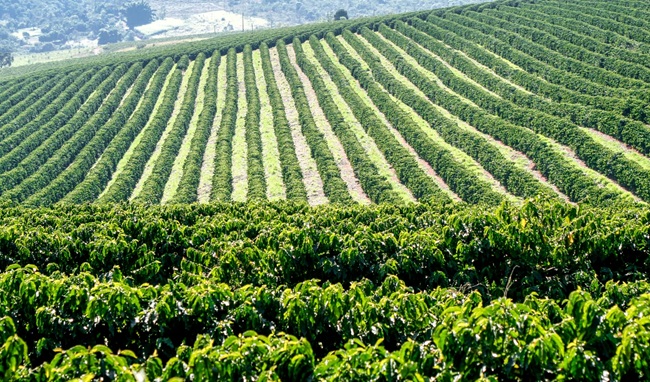
Terrain. This is the underrated one. Much Brazilian coffee grows on flat or gently rolling land, unlike the steep mountainsides of Colombia, Ethiopia or Guatemala. Flat land can be mechanically harvested, and mechanical harvesting transforms the economics of coffee farming. A machine does in hours what a picking crew does in days.
Altitude, or rather the lack of it. Brazilian coffee typically grows lower than its Latin American neighbors, commonly around 800 to 1,300 meters (2,600 to 4,300 feet). Lower altitude means faster cherry development, which means less acidity and more body and sweetness. This is usually framed as a limitation. For blending purposes it’s the entire point.
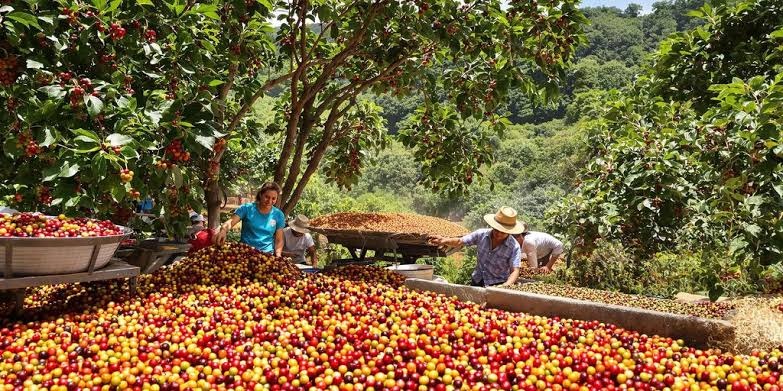
Climate for drying. Many Brazilian growing regions have a reliable dry season at harvest time, with low humidity. That makes natural processing, where cherries are dried whole in the open, practical at scale. In wetter origins, naturals are risky. In Brazil they’re the default.
A short, honest history
Coffee’s arrival in Brazil comes with a story that’s told everywhere and should be treated the way we treat the Kaldi legend: enjoyable, widely repeated, and not something to state as fact.
The tale goes that in the 1720s a Portuguese officer named Francisco de Melo Palheta was sent to French Guiana, ostensibly to mediate a border dispute but really to obtain coffee seeds, which the French guarded closely. He is said to have charmed the governor’s wife, who presented him at his farewell with a bouquet of flowers containing hidden coffee seedlings.
What’s not in dispute is what followed. Coffee became the engine of the Brazilian economy through the nineteenth century, and the wealth it generated shaped the country’s politics. The era when the São Paulo coffee interests and the Minas Gerais dairy interests traded the presidency between them is still known as café com leite politics.
It’s also important to be straightforward about the foundation of that early industry. Brazilian coffee was built on slave labor until abolition in 1888, after which the plantations turned substantially to European immigrant labor, particularly Italian. This history is routinely skipped in coffee writing, and it shouldn’t be. It’s part of how the industry became what it is.
The twentieth century added two more chapters worth knowing. In the 1930s, facing collapsed prices and vast surpluses, Brazil destroyed enormous quantities of coffee to prop up the market. Then in 1975 a catastrophic frost known as the Geada Negra, or Black Frost, devastated the crop, spiked world prices, and pushed Brazilian production north and west into less frost-prone areas, permanently reshaping the country’s coffee map.
Frost still moves the global coffee price. When you read about coffee futures jumping, check the weather in Minas Gerais.
The biennial cycle
One quirk of Brazilian production affects everyone.
Coffee plants tend toward biennial bearing, meaning a heavy-yielding “on” year followed by a lighter “off” year as the plant recovers. This happens everywhere, but because Brazil is such a large share of world supply, the Brazilian cycle is visible in global supply and price data.
If coffee prices seem to move in a two-year rhythm, that’s part of the reason.
The main Brazilian coffee growing regions
Minas Gerais
The heartland, and the largest producing state by a wide margin. It contains several distinct areas.
Sul de Minas gives you the classic Brazilian profile: chocolate, nuts, caramel, medium to full body. Rolling hills, huge production.
Cerrado Mineiro is a flat, high plateau with a sharply defined dry season, heavily mechanized, and Brazil’s first designated origin region. Cleaner and often brighter than Sul de Minas.
Mantiqueira de Minas sits higher and more mountainous, and it’s increasingly the source of Brazil’s most celebrated specialty lots.
Matas de Minas is steeper and more smallholder-dominated, with a growing specialty reputation.
Chapada de Minas is irrigated, mechanized and newer.
São Paulo
Mogiana, and specifically Alta Mogiana, sits on the São Paulo and Minas border. It has a long-standing reputation for quality: sweet, chocolatey, good body, often a step up in complexity from bulk Brazilian.
Espírito Santo
Brazil’s conilon (robusta) center, on the coast north of Rio. It also produces arabica in its higher inland areas, sold as Montanhas do Espírito Santo, which has developed a genuine specialty reputation.
Bahia
The northeast frontier, and unusual: flat, hot, and often irrigated, with highly mechanized, technologically advanced farms in the Cerrado and Oeste areas. Chapada Diamantina is the higher-altitude, more specialty-focused part of the state.
Paraná
Historically enormous, but repeatedly hit by frost. It’s the southernmost major region and the most exposed. Production declined substantially after 1975 and never returned to its former scale.
Rondônia
In the northwest Amazon region, and a growing center for conilon production.
Arabica and conilon
Brazil’s arabica goes into everything from commodity blends to Cup of Excellence lots. Its conilon, meaning Brazilian robusta, is a large industry in its own right, feeding instant coffee, domestic blends and export.
Worth knowing: Brazilian conilon has been the subject of serious agronomic work, and quality-focused conilon is considerably better than robusta’s general reputation suggests. It’s part of why “robusta is bad coffee” is a lazier claim than it used to be.
Brazilian coffee varieties
Brazil has its own varietal lineage, developed largely through decades of domestic agricultural research.
Mundo Novo is a natural Typica and Bourbon hybrid discovered in Brazil. Vigorous, productive, and widely planted.
Catuaí is a Mundo Novo and Caturra cross bred in Brazil. Compact, high-yielding, and now grown across Latin America. It comes in yellow and red fruiting forms.
Yellow Bourbon is a Brazilian yellow-cherry Bourbon, prized for sweetness and a smoother, more delicate cup than typical Brazilian coffee. If you want to taste Brazil at its most refined, this is where to look.
Icatu, Obatã, Topázio and Arara are later selections, many with disease resistance bred in.
Yellow Bourbon is the one to remember as a buyer. It appears on specialty bags and it genuinely tastes different.
Processing: Brazil’s real signature
If you take one technical thing from this article, it’s that Brazil’s flavor comes as much from processing as from geography.
Natural (dry) process
The traditional Brazilian method. Whole cherries are dried in the sun on patios called terreiros, with the fruit intact around the seed. The fruit sugars influence the bean directly, and the result is sweetness, body and low acidity.
Brazil’s dry harvest climate makes this reliable at a scale that would be reckless in wetter origins.
Pulped natural (cereja descascada)
This is a genuine Brazilian innovation, developed in the 1990s, and it’s more influential than most drinkers realize.
The outer skin is removed but the sticky mucilage is left on the bean, which is then dried. It sits between washed and natural: cleaner and more consistent than a full natural, sweeter and heavier-bodied than a washed coffee.
The honey process now celebrated in Costa Rica and elsewhere descends directly from this idea. Brazil invented the category and rarely gets credit for it.
Washed and experimental
Fully washed Brazilian coffee exists but is much less common. The specialty sector has been experimenting energetically with anaerobic and extended fermentations, sometimes producing coffees that taste nothing like conventional Brazil.
Brazilian coffee flavor profile
| Region or type | Typical flavor notes | Body | Acidity |
|---|---|---|---|
| Sul de Minas | Milk chocolate, hazelnut, peanut, caramel | Medium to full | Low |
| Cerrado Mineiro | Chocolate, caramel, mild citrus, clean | Medium | Low to medium |
| Mantiqueira de Minas | Chocolate, stone fruit, floral, sweet, complex | Medium | Medium |
| Mogiana | Chocolate, nuts, brown sugar, smooth | Medium to full | Low to medium |
| Espírito Santo (arabica) | Chocolate, caramel, mild fruit | Medium | Low to medium |
| Bahia | Chocolate, nuts, clean, consistent | Medium | Low |
| Yellow Bourbon | Sweet, delicate, almond, caramel, subtle fruit | Medium | Medium |
| Conilon (robusta) | Dark chocolate, wood, earth, heavy | Full | Very low |
The Brazilian signature is chocolate, nuts (especially hazelnut and peanut), caramel sweetness, heavy body, and notably low acidity.
That nuttiness is Brazil’s fingerprint. Once you’ve identified it, you’ll start noticing it in blends everywhere.
Why Brazilian coffee is in almost every blend
Here’s the payoff. Six reasons, and price is only one of them.
1. Body. Brazilian coffee brings weight and mouthfeel. Blends built entirely from bright, high-grown Central Americans and East Africans can taste thin and sharp. Brazil gives them a floor to stand on.
2. Sweetness without acidity. This is the crucial one. Most origins that bring sweetness also bring acidity. Brazil brings caramel and chocolate sweetness with very low acidity, which means it can buffer sharper components without muddying them. A blender can add brightness from Kenya or Ethiopia and rely on Brazil to keep it drinkable.
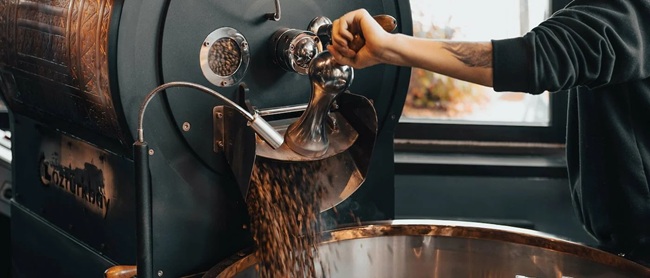
3. Crema. Natural and pulped-natural processing, combined with the bean’s oil content, produces excellent crema in espresso. Traditional Italian espresso is built on exactly this.
4. Consistency and volume. A roaster building a year-round house blend needs a component available in quantity, at a predictable profile, every year. Very few origins can promise that. Brazil can.
5. It roasts forgivingly. Brazilian coffee takes medium and darker roasts without turning ashy as quickly as more delicate origins. For a blend that has to survive a café’s roast profile and a barista’s variable technique, that resilience matters.
6. Price. Yes. Mechanization and scale make Brazilian coffee affordable, and that’s what makes a blend commercially viable. But if price were the only factor, roasters would buy the cheapest coffee available and they don’t. They buy Brazil, specifically, for the qualities above.
And then there’s the milk test. Brazilian coffee survives steamed milk better than almost anything else. Chocolate and nut notes cut through dairy, while delicate florals disappear into it. If your café’s flat white tastes of chocolate and hazelnut, thank Brazil.
“Santos” is not a region
A quick myth-bust, in the same family as Colombia’s Supremo and Kenya’s AA.
You’ll see “Brazil Santos” or simply “Santos” on coffee bags constantly, often presented as though it’s a growing region or a quality mark.
Santos is a port. It’s the harbor near São Paulo through which a vast amount of Brazilian coffee has historically been exported. The name tells you where the coffee left the country, not where it grew or how good it is.
Historically it did carry some association with better-quality lots, which is why it stuck as a marketing term. Today it’s largely decorative.
Brazil also grades coffee in ways that confuse newcomers: by defect count on a numbered type scale, by screen size, and by cup character using descriptors that run from Strictly Soft and Soft down through Hard, Riada and Rio. That last one describes a harsh, medicinal, iodine-like taint, considered a defect in specialty markets though historically appreciated in some traditional ones.
What actually predicts quality: region, farm, altitude, variety, processing method, and roast date. As always.
Specialty Brazil is real, and better than its reputation
Brazil has an image problem in specialty coffee. It’s dismissed as the bulk origin, fine for blends but not worth seeking out.
That’s outdated, and there’s a strong piece of evidence against it. The Cup of Excellence competition, now run in producing countries worldwide, began in Brazil. The country that supposedly only makes commodity coffee hosted the origin of the modern specialty auction system.
Higher-altitude regions like Mantiqueira de Minas and Chapada Diamantina, careful producers working with Yellow Bourbon, and experimental fermentation lots are producing Brazilian coffee that is complex, distinctive and genuinely exciting.
It won’t taste like an Ethiopian, and it isn’t trying to. But a top Brazilian microlot is a very good coffee by any standard, and it usually costs meaningfully less than an equivalent-quality lot from a fashionable origin.
How to buy Brazilian coffee
1. Don’t buy on “Santos.” It’s a port.
2. Look for a region. Sul de Minas, Cerrado Mineiro, Mogiana, Mantiqueira. These mean something.
3. Look for the variety. Yellow Bourbon in particular is worth paying for.
4. Check the processing. Natural for maximum sweetness and body. Pulped natural for a cleaner but still sweet cup. Washed if you want to see the underlying coffee.
5. Check the roast date. Two to four weeks, as always.
6. Choose your roast level by purpose. Brazil handles a wide range. Medium is the sweet spot for filter and keeps the sweetness and nuttiness. Medium-dark is excellent for espresso and milk drinks. Dark works better here than with most origins, though you’ll lose nuance.
7. Buy it as an espresso base. If you’re building a home espresso habit, a good Brazilian is one of the best-value single origins you can buy: forgiving, sweet, and it makes crema readily.
8. Consider it for beginners. Low acidity and low bitterness make Brazilian coffee approachable for people who’ve decided they don’t like coffee. Often they don’t like sharp or burnt coffee, which is a different thing.
How to brew Brazilian coffee
Brazil’s low acidity changes what you’re aiming for. Under-extracted Brazilian coffee doesn’t taste sour and bright. It tastes flat and dull, which is a harder fault to diagnose.
Espresso, Brazil’s home ground
- Ratio: 1:2, so 18g in and 36g out
- Time: 25 to 32 seconds
- Roast: medium to medium-dark
Sweet, chocolatey, heavy-bodied, generous crema, and forgiving of small errors. If you’re learning espresso, learn on Brazil.
French press
An excellent match. The full body suits immersion brewing, and the metal filter passes through oils that reinforce the mouthfeel.
- Ratio: 1:15 to 1:16
- Steep: 4 minutes, then decant immediately
Pour-over and filter
Works well, but push a little harder than you would with a bright coffee.
- Ratio: 1:15 to 1:16, slightly stronger than the 1:16 to 1:17 you’d use for an Ethiopian
- Water: 93 to 96°C (200 to 205°F)
- Grind: medium to medium-fine. If it tastes flat, go finer
Milk drinks
Ideal. This is what Brazilian coffee is best at outside espresso, and it’s why your café uses it.
Moka pot
Also excellent. The body and low acidity stand up to the moka pot’s intensity in a way that delicate coffees don’t.
The pressures facing Brazilian coffee
Climate. Brazil has been hit by severe drought and frost events in recent years, with significant crop damage and global price consequences. Rising temperatures threaten the viability of some current growing areas, and Brazil’s relatively low-altitude production has less room to retreat uphill than mountainous origins.
Price volatility. Brazil’s dominance means Brazilian weather sets the world price, which is good for Brazilian growers in a shortage and brutal in a glut.
Labor. This deserves plain speaking. There have been documented cases of severe labor exploitation on Brazilian coffee farms, investigated by Brazilian authorities, who maintain enforcement mechanisms and a public register of employers found to have used forced labor.
This is not a claim about Brazilian coffee generally. The great majority is produced legitimately, and Brazil’s enforcement apparatus is more developed than in many producing countries. But the issue is real and documented, and it’s a reason traceability and credible certification matter. If ethical sourcing is important to you, buy from roasters who can tell you which farm your coffee came from.
The mechanization trade-off. Machine harvesting takes ripe and unripe cherries together, which caps quality at the top end. Brazil’s best lots are still selectively hand-picked, which is part of what you’re paying for in a microlot.
Frequently asked questions
What does Brazilian coffee taste like? Chocolate, hazelnut and peanut, caramel sweetness, heavy body and low acidity. Smooth and approachable rather than bright or complex.
Why is Brazilian coffee in so many blends? It provides body, sweetness without acidity, excellent crema and year-round consistency at scale, and it buffers sharper origins without muddying them. Price helps, but it isn’t the main reason.
What is Brazilian Santos coffee? Coffee exported through the port of Santos. It’s a shipping term, not a growing region or quality grade.
Is Brazilian coffee good quality? It ranges from bulk commodity to Cup of Excellence lots. Specialty Brazilian coffee is genuinely excellent and usually better value than equivalent quality from more fashionable origins.
Is Brazilian coffee arabica or robusta? Both. Arabica dominates, but Brazil is also a major producer of robusta, known locally as conilon.
Is Brazilian coffee strong? It’s full-bodied but low in acidity and generally low in harshness. Strong in the sense of heavy and smooth, rather than sharp or aggressive.
What is pulped natural coffee? A Brazilian process where the skin is removed but the sticky mucilage is left on during drying. It sits between washed and natural, and it’s the ancestor of honey processing.
What is Yellow Bourbon? A yellow-cherry Bourbon variety associated with Brazil, prized for sweetness and a more delicate, refined cup than typical Brazilian coffee.
Is Brazilian coffee good for espresso? It’s one of the best. Sweet, chocolatey, heavy-bodied, forgiving, and it produces excellent crema. It’s the backbone of traditional Italian espresso.
Why does Brazilian coffee have low acidity? Mostly altitude and processing. Brazilian coffee grows lower than most Latin American origins, so cherries develop faster and produce less acidity, and natural processing emphasizes sweetness and body over brightness.
Does a bad Brazilian harvest affect coffee prices everywhere? Yes. Brazil is such a large share of world supply that its frosts and droughts move global coffee prices, including for coffee grown nowhere near Brazil.
Final thoughts
Brazilian coffee is the least glamorous origin in specialty coffee and one of the most important. It’s the bass player. You notice it most when it’s missing.
If you’ve been buying bright, fashionable single origins and finding your espresso thin or your milk drinks disappointing, the problem may not be your technique. It may be that you’re brewing coffee that was never designed for the job.
Buy a Yellow Bourbon or a Mantiqueira de Minas lot, pulped natural, medium roast, and pull it as espresso. Then put it in milk. It’ll do things your Ethiopian never could.
And the next time you read the back of a blend bag and see Brazil listed first, you’ll know exactly what it’s doing there.
Brazilian coffee is one of many origins worth exploring. For the full picture of where coffee grows and why it tastes different from place to place, see our guide to coffee bean origins.
