

Have you ever wondered, where does coffee actually come from? Not the café down the road. Not the supermarket shelf. The actual plant.
Most of us drink coffee every day without ever thinking about the fact that it grew somewhere. On a specific hillside, at a specific altitude, tended by specific people, and picked in a specific season. And yet almost everything you notice in the cup traces back to that hillside.
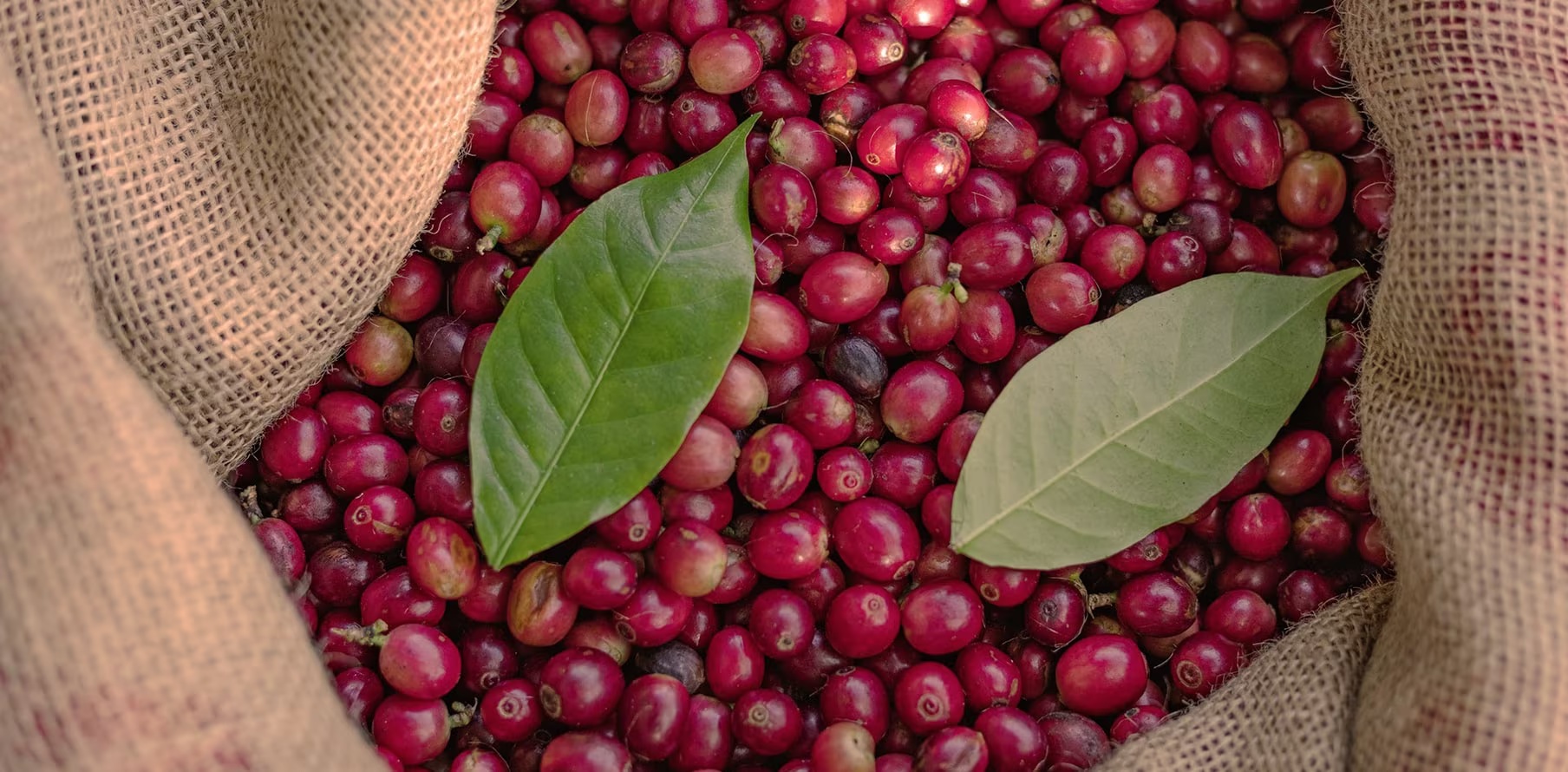
Here’s the thing that surprises most people: coffee is a fruit. The “bean” is a seed. It grows inside a small red or yellow berry called a coffee cherry, on a shrubby evergreen plant, in a fairly narrow band of the world where the conditions happen to be right.
That band is why a bag of Ethiopian coffee can taste like blueberries and jasmine while a bag of Brazilian coffee tastes like dark chocolate and roasted almonds, using the same brewer, the same water and the same person making it.
Coffee doesn’t taste the same everywhere because coffee doesn’t grow the same way everywhere.
This guide walks through where coffee comes from, how the major growing regions differ, and crucially. How much of what you taste is actually down to origin versus everything that happens afterwards. By the end you’ll be able to look at a bag of beans, read what’s on the label, and make a reasonable guess about what’s waiting in the cup.
Where Does Coffee Come From?
Before we get to countries, it helps to understand what we’re actually growing.
Coffee Is a Fruit
Coffee grows on plants in the genus Coffea. Evergreen shrubs that, left alone, would grow into small trees. Farms usually keep them pruned to a manageable picking height.
The plant flowers with small white blossoms that smell remarkably like jasmine. Those blossoms become green fruit, which ripen over several months into what the industry calls coffee cherries. Usually deep red, sometimes yellow or orange depending on the variety.
Inside each cherry, you’ll typically find two seeds sitting flat-side to flat-side. Those seeds are what we call coffee beans.
Occasionally a cherry produces just one rounded seed instead of two. That’s a peaberry, and some producers sort and sell them separately. Whether peaberries actually taste better is debated. They roast a little differently because of the shape, but the “peaberries are superior” claim is more marketing than established fact.
After picking, the fruit has to come off the seed, the seed has to be dried, and the papery parchment layer around it has to be removed. What’s left is a pale, hard, greenish seed, green coffee. Which smells faintly of hay and tastes of almost nothing. All the aroma and flavor you associate with coffee is created later, in roasting.
So “bean” is technically a bit misleading. It’s a seed, from a fruit, that gets dried and then cooked. But “bean” won that argument centuries ago, and we’re not going to win it back here.
Where Did Coffee Originally Come From?
Coffee’s story begins in Ethiopia, where Coffea arabica still grows wild in the forests of the southwest highlands. Ethiopia is the plant’s genetic homeland, which is part of why Ethiopian coffee is so wildly diverse. The country holds a genetic library that the rest of the coffee world has only sampled from.
The much-loved legend of Kaldi, the goat herder who noticed his goats behaving strangely after eating the berries, is exactly that: a legend. It appears in written form centuries after the events it describes, and there’s no way to verify it. It’s a lovely story and worth knowing, but it shouldn’t be presented as history.
What’s better documented is coffee’s cultivation and trade through Yemen, across the Red Sea. Yemen is where coffee moved from wild plant to cultivated crop and traded commodity, exported through the port of Mocha. A name that eventually got attached to the chocolate-and-coffee drink, by way of the chocolatey character of the coffees shipped from there.
How Did Coffee Spread Around the World?
Roughly, and with a great deal of intrigue, theft and colonial expansion compressed into a few lines:
- Ethiopia — the plant’s origin
- Yemen — first serious cultivation and trade
- The Middle East and Ottoman world — coffeehouses, and the drink becoming a social institution
- India — seeds carried out of Arabia, traditionally credited to the pilgrim Baba Budan
- Southeast Asia — Dutch cultivation in Java and across the Indonesian archipelago
- The Caribbean — French, Dutch and Portuguese plantings
- Central and South America — where coffee found the conditions that would eventually make it a global commodity crop
- Today — grown commercially across dozens of countries in the tropics
One consequence of that history matters for what you drink: most of the world’s arabica descends from a very small founding population that left Ethiopia. The genetic diversity of commercial coffee is startlingly narrow, which is a real vulnerability when it comes to disease and a changing climate.
What Is the Coffee Belt?
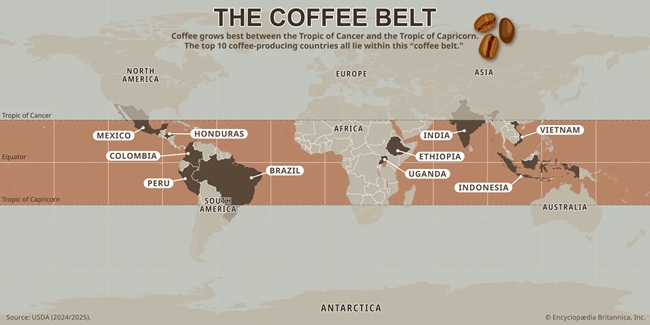
If you look at a map of coffee production, the pattern is immediately obvious. Coffee grows in a band around the middle of the planet.
Where Is the Coffee Belt?
The Coffee Belt, sometimes called the Bean Belt. Which is the tropical zone roughly between the Tropic of Cancer (about 23.5° north) and the Tropic of Capricorn (about 23.5° south).
Draw those two lines on a world map and virtually every commercial coffee-growing country sits between them: Brazil, Colombia, Ethiopia, Kenya, Vietnam, Indonesia, Guatemala, Honduras, India, Papua New Guinea and dozens more.
There are a handful of edge cases just outside or right on the line, parts of Australia and Hawaii among them, but the rule holds remarkably well.
Why Does Coffee Grow in This Region?
Coffee is fussy. The tropics offer a specific combination of conditions it needs:
Temperature. Arabica does best in a moderate range, roughly 18–22°C (64–72°F). Too hot and the cherries ripen too quickly, developing less complexity. Too cold and the plant simply stops.
Frost sensitivity. This is the hard limit. Arabica has essentially no frost tolerance. A single frost event can destroy a crop and damage plants for years. Brazilian frosts have historically moved global coffee prices on their own.
Rainfall. Coffee needs substantial, reasonably reliable rain and, importantly, a dry period to trigger flowering and to allow drying after harvest. Rain at the wrong moment is as much a problem as no rain at all.
Sunlight. Coffee evolved as a forest understorey plant. It tolerates full sun and is often grown that way for yield. Many of the most interesting coffees are grown under shade trees, which slows ripening and moderates temperature.
Elevation. In the tropics, altitude is how you get cool temperatures without leaving the warm latitudes. This is why so much good coffee comes from mountains.
Soil. Coffee prefers deep, well-drained, slightly acidic soil with good organic content. Volcanic soils have a strong reputation, and there’s something to it though as we’ll see, the effect is often overstated.
Seasonality. Because growing regions sit on both sides of the equator, harvests happen at different times of year in different countries. There’s no single global coffee season, which is why freshly-harvested coffee is always available somewhere.
Coffee Belt Map
Production note: A world map showing the Coffee Belt with major producing countries marked is the single most valuable visual asset for this page. Build it as an original graphic, it will earn links and gets reused across the whole Beans silo.
The World’s Major Coffee Growing Regions
Coffee origins are usually grouped into three broad regions, and while the boundaries are rough, the generalisations are useful as a starting point:
- Central and South America — the volume producers, and the home of balanced, approachable, chocolate-and-caramel coffees
- Africa — the most distinctive and aromatic coffees, often floral, fruity and brightly acidic
- Asia and the Pacific — lower-acid, fuller-bodied and often earthier coffees, plus the bulk of the world’s robusta
Hold these loosely. There are floral Colombians and chocolatey Ethiopians. Regional generalisations are a starting point for exploration, not a set of rules.
Coffee Origins in Central and South America
The Americas produce a very large share of the world’s coffee, and an even larger share of the coffee most people actually drink. If you’ve had a cup today, there’s a good chance the beans came from this region.
The geography helps: long mountain ranges running through the tropics create enormous areas of high-altitude land at the right latitude, with volcanic soils and reliable wet and dry seasons.
Brazil
Brazil is the giant. It has been the world’s largest coffee producer for well over a century, and it produces so much that Brazilian harvest conditions influence global coffee prices on their own.
Unusually, Brazil grows both arabica and robusta at scale (robusta is generally called conilon there). Major growing areas include Minas Gerais. Particularly Sul de Minas and Cerrado Mineiro, along with São Paulo, Espírito Santo and Bahia.
Brazilian farms tend to sit at lower elevations than their Central American neighbors, and the terrain in many regions is gentle enough for mechanical harvesting — a significant part of why Brazil can produce at the scale and price it does.
The classic Brazilian processing method is natural (dried whole in the cherry), which contributes sweetness and body. Pulped natural and honey processing are also common.
Typical flavor profile: Chocolate, nuts, caramel, low acidity and heavy body.
That profile is exactly why Brazil is the backbone of so many espresso blends. It provides sweetness, body and crema-friendly structure without any sharp edges.
Colombia
If Brazil is the volume, Colombia is the reputation. Decades of coordinated marketing made “Colombian coffee” a household phrase, and the country’s mountainous geography genuinely does produce excellent coffee.
Colombia grows arabica only. The Andes split into three ranges as they run through the country, creating an enormous quantity of high-altitude growing land with varied microclimates. Key regions include Huila, Nariño, Antioquia, Tolima, Cauca, Santander and Quindío.
Colombian coffee is almost entirely washed, and much of it is produced by smallholders processing on their own farms.
Because Colombia sits close to the equator with regions on both sides of the mountains, some areas manage two harvests a year — a main crop and a secondary mitaca.
Typical flavor profile: Balanced, caramel sweetness, chocolate, gentle citrus and a clean, medium acidity.
Colombia is the safe recommendation for someone who wants a coffee that’s clearly good without being challenging.
Guatemala
Guatemala punches well above its size, largely thanks to volcanic soils and dramatic altitude.
The national coffee association recognizes several distinct growing regions, and they genuinely do produce different coffees. Antigua, ringed by volcanoes, is the most famous. Huehuetenango, high and dry in the northwest, produces some of the country’s brightest and most complex coffees. Atitlán, Cobán, Fraijanes, San Marcos and Nuevo Oriente each have their own character.
This is a good place to introduce microclimates. Antigua and Huehuetenango are both Guatemalan, both high-altitude, both washed arabica — and they taste noticeably different. Country of origin is a coarse tool.
Typical flavor profile: Chocolate, warm spice, citrus and stone fruit, with a fuller body than most Central Americans.
Costa Rica
Costa Rica built its reputation on quality control and, more recently, on processing innovation.
The country’s micro-mill revolution — small farms building their own processing facilities rather than selling cherry to large mills — gave producers direct control over how their coffee was processed, and made Costa Rica one of the most important places in the development of honey processing.
Tarrazú is the best-known region, along with West Valley, Central Valley, Tres Ríos, Brunca, Orosi, Turrialba and Guanacaste.
Costa Rica has historically had unusually strict rules about coffee production, including a long-standing restriction on planting robusta — a policy that’s since changed.
Typical flavor profile: Bright, clean acidity, citrus, stone fruit, honeyed sweetness and clarity.
Honduras
Honduras has grown enormously in importance and is now the largest producer in Central America. For years its coffee was exported anonymously into blends; that’s changed substantially.
Recognized regions include Marcala, Copán, Montecillos, Comayagua, Opalaca and El Paraíso. Much of the production is high-altitude smallholder arabica.
Typical flavor profile: Chocolate, caramel, mild fruit and nuts — often excellent value.
Mexico
Mexico’s growing regions sit in the south, principally Chiapas, Veracruz and Oaxaca, with the highest-altitude coffee generally coming from Chiapas.
Mexico is significant in organic and certified coffee, with a long history of cooperative production among smallholder and indigenous farming communities.
Typical flavor profile: Chocolate, nuts, caramel, mild fruit and a light, easy-drinking body.
Peru
Peru is one of the world’s largest producers of certified organic coffee, grown largely by smallholders across mountainous terrain.
Key regions include Cajamarca, Amazonas, San Martín, Junín, Cusco and Puno. Infrastructure challenges have historically made it hard to get Peru’s best coffee to market as its best coffee — but that’s improving, and there are excellent Peruvian microlots now.
Typical flavor profile: Chocolate, nuts, gentle citrus and soft fruit, with mild acidity.
Other Central and South American Coffee Origins
Worth knowing, and worth trying when you see them:
- Panama — small production, enormous reputation. The Geisha (or Gesha) variety grown in Boquete has repeatedly broken world auction price records. Extraordinary, floral, tea-like, and eye-wateringly expensive.
- El Salvador — home to the Pacamara variety and some beautiful, delicate coffees; production has been affected by decades of difficulty including coffee leaf rust.
- Nicaragua — increasingly strong specialty production, particularly from Jinotega and Nueva Segovia.
- Ecuador — small volumes, but unusual in growing coffee at very high altitudes and increasingly interesting.
- Bolivia — tiny production, mostly smallholder, capable of exceptional quality.
- Venezuela — a historically significant producer whose export volumes have declined dramatically.
African Coffee Origins
If Central and South America produce the coffee most people drink, Africa produces the coffee that makes people fall in love with coffee.
African coffees are frequently the most aromatic and distinctive on the shelf, floral, fruity, tea-like, sometimes so unlike “normal” coffee that first-time drinkers assume something’s been added. Nothing has. That’s just what the coffee tastes like.
Ethiopia
Ethiopia deserves more space than any other origin, because it’s genuinely different.
It’s coffee’s genetic homeland. Arabica still grows wild in Ethiopian forests, and Ethiopian cultivated coffee is often described on bags simply as “heirloom”. A catch-all acknowledging that the country contains thousands of local varieties, many of them uncatalogued. Nowhere else has this diversity.
Ethiopian coffee is also grown differently. A great deal comes from garden coffee, small plots around family homes, intercropped with food crops rather than dedicated plantations.
The major growing areas each have real character:
- Yirgacheffe — the most celebrated. Intensely floral, citrus, jasmine and bergamot, often startlingly tea-like.
- Sidamo (Sidama) — the broader surrounding region, with enormous variation; often citrus, berry and floral.
- Guji — increasingly prized in its own right, frequently vivid and fruit-forward.
- Harrar — in the east, traditionally natural-processed, with blueberry and wine-like intensity.
- Limu, Jimma, Kaffa — significant producing areas in the southwest.
Both washed and natural processing are important in Ethiopia, and they produce dramatically different results. A washed Yirgacheffe is delicate, floral and clean. A natural Yirgacheffe from the same area can taste like strawberry jam.
Typical flavor profile: Floral, jasmine, bergamot, citrus, berries, stone fruit, tea-like body, bright acidity.
If you’ve only ever had chocolatey supermarket coffee, a good washed Ethiopian is the single most likely bag to change your mind about what coffee can be.
Kenya
Kenyan coffee has a signature so recognizable that experienced drinkers can often pick it blind.
Kenya grows arabica, at high altitude, with a heavily-structured system: much of the coffee is processed at cooperative factories (washing stations), then sold through a weekly auction system. The distinctive SL-28 and SL-34 varieties, selected in Kenya decades ago, contribute a great deal to the cup character, alongside newer disease-resistant varieties like Ruiru 11 and Batian.
Kenyan processing typically involves a double fermentation and extended washing, which is part of the reason for the clarity in the cup.
One thing worth clearing up: the AA grading you see on Kenyan bags refers to screen size. How big the bean is not quality. Large beans often correlate with good growing conditions, but AA is not a quality certification, and there are superb Kenyan AB lots.
Typical flavor profile: Blackcurrant, ripe berries, grapefruit, tomato-like savouriness, intense and juicy acidity.
Uganda
Now Uganda is one of Africa’s largest coffee exporters, and unusual in that robusta grows wild there. Uganda is part of robusta’s native range, which very few countries can claim.
Most Ugandan production is robusta, but the arabica grown on the slopes of Mount Elgon (often sold as Bugisu) and in the Rwenzori mountains is worth seeking out, and the specialty sector is growing.
Rwanda
Rwanda’s coffee sector was rebuilt largely around washing stations and smallholder cooperatives, and the results have been remarkable.
Most Rwandan coffee is Bourbon variety, grown at high altitude, washed. Nyungwe, Huye, Kivu and Gakenke are notable areas.
One quirk worth knowing: Rwandan and Burundian coffees occasionally suffer from the “potato defect”. A raw-potato aroma in an individual bean, caused by bacterial damage linked to the antestia bug. It affects single beans rather than whole lots, and it’s not a reflection of the producer’s care.
Typical flavor profile: Red fruit, citrus, floral notes, tea-like delicacy and a clean, sweet finish.
Burundi
Small, landlocked and mountainous, Burundi produces high-altitude washed Bourbon of real quality, particularly from Kayanza and Ngozi. Similar in character to Rwandan coffee, and similarly subject to the potato defect.
Tanzania
Tanzania grows arabica in the north around Kilimanjaro and Mount Meru, and in the south around Mbeya and Mbozi, along with robusta near Lake Victoria.
Also Tanzania is strongly associated with peaberry lots, which are sorted and marketed separately and have become something of a national calling card.
Typical flavor profile: Bright acidity, black tea, citrus and stone fruit, often described as Kenya-adjacent but gentler.
Yemen
Not to be left out, given its historical role. Yemeni coffee is produced in tiny quantities on ancient terraced farms, dried in the cherry, and tastes like almost nothing else, wild, winey, spiced and fermented. Production has been severely affected by conflict, and genuine Yemeni coffee is rare and expensive.
Asian and Pacific Coffee Origins
Asian and Pacific coffees are the most frequently misunderstood group, partly because the region contains both the world’s largest robusta producer and some of the most distinctive arabica on earth.
The generalisation, lower acidity, fuller body, earthy and spicy character. It holds for some famous origins and completely fails for others.
Indonesia
Indonesia is an archipelago, and its coffees vary as much as you’d expect across thousands of islands.
- Sumatra — the most famous. Mandheling, Lintong and Gayo (from Aceh) are the names to know.
- Java — historically enormous; the reason “java” became slang for coffee.
- Sulawesi — particularly Toraja, a highland region producing clean, complex coffee.
- Bali — Kintamani, grown alongside citrus trees in a distinctive cooperative system.
- Flores, Papua and others — smaller but increasingly visible.
What makes Indonesian coffee taste Indonesian is largely a processing method: giling basah, or wet-hulling. The parchment is removed from the bean while it still holds a high moisture content, which produces the characteristic dark bluish-green raw bean and the signature cup, low acidity, heavy body, earthy, herbal, sometimes cedar or tobacco notes.
People tend to either love this profile or bounce off it entirely. Both reactions are reasonable.
A note on kopi luwak: the “civet coffee” passed through the digestive tract of an Asian palm civet. It’s marketed as a luxury, it’s frequently faked, the quality claims are unsupported, and the modern industry commonly involves caging wild animals in poor conditions. It’s worth knowing about mainly so you can decline it.
Typical flavor profile: Earthy, herbal, spicy, cedar, dark chocolate, very full body, very low acidity.
Vietnam
Vietnam is the world’s dominant robusta producer and one of the largest coffee producers overall. A position it built extraordinarily quickly from the 1980s onward.
Most production is in the Central Highlands, around Dak Lak and Buon Ma Thuot. There’s also a small but growing arabica sector, notably around Da Lat in Lam Dong.
It’s worth separating two different things that both get called “Vietnamese coffee”:
- Vietnam as a growing origin — mostly robusta, mostly destined for instant coffee, blends and commodity markets.
- Vietnamese coffee as a drinking tradition — the phin filter, dark roast, condensed milk, egg coffee, cà phê sữa đá. This is one of the world’s great coffee cultures and deserves attention on its own terms.
Typical flavor profile (robusta): Strong, heavy-bodied, earthy, dark chocolate, woody, with pronounced bitterness and roughly double the caffeine of arabica.
India
India grows both arabica and robusta, principally in Karnataka (especially Kodagu/Coorg and Chikmagalur), Kerala and Tamil Nadu.
Two things make Indian coffee distinctive.
First, much of it is genuinely shade-grown under multi-tier canopies, often intercropped with pepper, cardamom and other spices, an approach with real biodiversity benefits.
Second, Monsooned Malabar: green coffee deliberately exposed to monsoon winds and moisture in open warehouses, causing the beans to swell and pale. The process originated as an accident — coffee shipped to Europe in the hold of sailing ships arrived transformed — and was later recreated deliberately. The result is very low acidity, heavy body and a musty-sweet character that works remarkably well in espresso.
India is also where coffee arrived from Arabia, traditionally credited to Baba Budan and the hills that now carry his name.
Papua New Guinea
PNG grows arabica in the Eastern Highlands, Western Highlands and Simbu provinces, largely on smallholder “garden” plots.
Some PNG plantings trace back to Jamaican Blue Mountain seed stock, and the coffee often shows more brightness and fruit than its Indonesian neighbors — a useful reminder that “Asia-Pacific” is not a flavor category.
Typical flavor profile: Sweet, fruity, herbal, medium body, more acidity than Indonesian coffees.
Other Asian and Pacific Coffee Origins
- Thailand — northern highland arabica, a fast-improving specialty scene
- Myanmar — a young specialty sector producing some genuinely exciting coffee
- Laos — Bolaven Plateau, both arabica and robusta
- The Philippines — one of very few countries growing all four commercial Coffea species
- China — significant and growing production, mostly in Yunnan
- Timor-Leste — home of the Hybrido de Timor, a natural arabica-robusta hybrid that became the parent of many disease-resistant varieties worldwide
- Hawaii — Kona in particular; tiny volumes, high prices, and a persistent problem with “Kona blends” containing very little Kona
- Australia — see the FAQ below
How Does Coffee Origin Affect Flavor?
Here’s where a lot of coffee writing goes wrong. Origin gets treated as though it determines flavor. It doesn’t. It sets a range of possibilities.
Climate
Temperature and rainfall govern how quickly cherries ripen. Slower, cooler ripening generally allows more sugars and organic acids to develop in the seed. Fast ripening in hot conditions tends to produce a flatter cup.
Altitude
Higher elevation means cooler temperatures, which means slower ripening, which tends to mean denser beans with more acidity and more complexity.
This is why you see altitude on specialty bags, and why grading systems like SHB (Strictly Hard Bean) and SHG (Strictly High Grown) exist — they’re altitude classifications, used in Guatemala, Costa Rica, Honduras and elsewhere.
But the thresholds vary by country, and importantly what matters is the temperature, not the number. High altitude in Ethiopia and high altitude in Colombia mean different things because the latitudes differ.
Soil
Volcanic soils have a genuine reputation, and there’s a plausible mechanism: good drainage, mineral content, depth.
That said, soil’s direct effect on flavor is routinely overstated in coffee marketing. Plants don’t take up “minerality” and pass it into the cup the way wine writing sometimes implies. Soil affects plant health, and healthy plants produce better fruit. The link is real but indirect.
Coffee Variety
This is the underrated one. Variety the specific cultivar can matter as much as country.
Geisha grown in Panama tastes dramatically different from Caturra grown on the neighboring farm. Kenya’s SL-28 contributes a great deal to that famous blackcurrant character. Ethiopian heirloom varieties are a category of their own.
If two bags from the same country taste nothing alike, variety is often why.
Processing Method
Processing may be the single biggest lever after variety and it’s fully within human control.
- Washed — fruit removed before drying. Clean, clear, acidity-forward. Lets origin character show.
- Natural — dried whole in the cherry. Fruity, sweet, heavier, sometimes boozy or jammy.
- Honey / pulped natural — partial fruit removal. Sits between the two; sweet with moderated acidity.
- Wet-hulled — the Indonesian method. Earthy, heavy, low acid.
- Anaerobic and experimental — controlled fermentation producing intense, sometimes wild flavors.
A washed and a natural lot from the same trees, same farm, same harvest can taste like different coffees. That’s how much processing matters.
Roasting
And then roasting can flatten all of it.
Roast a delicate washed Ethiopian dark enough and you will taste roast, carbon, bitterness, smoke. Its essentially none of the floral character you paid for. Origin character survives light and medium roasting. Dark roasting progressively replaces it.
This is why a dark-roasted single-origin is often a waste of money, and why supermarket “Ethiopian” coffee sometimes tastes like nothing in particular.
The key takeaway:
Origin matters — but origin, variety, environment, processing, roasting and brewing together determine what ends up in your cup. Origin is the first word of the sentence, not the whole sentence.
Coffee Growing Regions and Typical Flavor Profiles
| Region | Common characteristics |
|---|---|
| Brazil | Chocolate, nuts, caramel, heavy body, low acidity |
| Colombia | Balanced, caramel, chocolate, citrus, medium acidity |
| Guatemala | Chocolate, spice, citrus, stone fruit |
| Costa Rica | Bright acidity, citrus, honey sweetness, clean |
| Honduras | Chocolate, caramel, mild fruit, nuts |
| Mexico | Chocolate, nuts, light body, mild |
| Peru | Chocolate, nuts, gentle citrus, soft |
| Ethiopia | Floral, jasmine, berries, citrus, tea-like |
| Kenya | Blackcurrant, berry, grapefruit, intense acidity |
| Rwanda | Red fruit, citrus, floral, clean sweetness |
| Tanzania | Black tea, citrus, stone fruit, bright |
| Indonesia | Earthy, herbal, spicy, very full body, low acidity |
| Vietnam | Strong, woody, dark chocolate, bitter, heavy |
| India | Low acidity, heavy body, spice, musty-sweet (monsooned) |
| Papua New Guinea | Sweet, fruity, herbal, medium body |
Read this table as tendencies, not guarantees. A natural-processed Colombian can taste more like an Ethiopian than like the Colombian profile above. These are useful defaults for choosing a bag, not laws of nature.
What Are Single-Origin Coffee Beans?
What Does Single Origin Mean?
“Single origin” means the coffee comes from one identifiable source rather than being blended from several.
The term is loosely defined, which is worth knowing. It can mean a single country, a single region, a single cooperative, a single farm, or a single lot from a single farm. “Single origin Brazil” and “single origin Lot 14, Finca Los Nogales, 1,750m, Caturra, washed” are both technically single origin, and they are not remotely the same claim.
Single Farm vs Single Region vs Single Country
Roughly in ascending order of specificity:
- Single country — broad. Says something about general character, little else.
- Single region — more useful. Antigua tells you more than Guatemala.
- Single cooperative or washing station — meaningful, especially in East Africa.
- Single farm or estate — specific, traceable.
- Single lot / microlot — a defined batch, often a single variety and processing method.
More specificity usually means more traceability, more accountability, and often, a higher price.
Is Single-Origin Coffee Better?
No. It’s different.
Single origin is better for tasting a place. It shows you what a particular origin, variety and processing method produce, and it’s the right choice for filter brewing where you want clarity and character.
Blends are better for consistency and balance. More on that shortly.
Anyone who tells you single origin is inherently superior is selling something.
Why Do Coffee Drinkers Care About Origin?
Three reasons, all legitimate:
- Flavor exploration. Origin is the most interesting map for finding coffees you like.
- Traceability. Knowing where coffee comes from allows questions about how producers are paid.
- Consistency of preference. Once you know you love Kenyan coffee, origin gives you a reliable way to find more of it.
Can You Taste the Difference Between Origins?
Yes, more easily than most beginners expect, provided two conditions are met.
First, the coffee needs to be lightly or medium roasted. Dark roasting erases origin character.
Second, taste them side by side. Differences that are subtle in isolation are obvious in comparison. Brew a Brazilian and an Ethiopian at the same time, in the same brewer, and taste them alternately. Almost nobody fails to notice the difference.
That side-by-side comparison is genuinely the fastest way to develop your palate, and it costs nothing but two bags of coffee.
Coffee Origin vs Coffee Blend
Why Are Coffee Beans Blended?
Blending has a slightly tarnished reputation, mostly because it can be used to hide poor-quality beans. But good blending is a craft, and roasters do it for sound reasons:
Consistency. Crops vary by season. A house blend can taste the same in March and October because the roaster adjusts the components. A single-origin can’t do that.
Balance. Different origins contribute different things. Brazilian body and sweetness, Ethiopian aromatics, Colombian structure. A blend can be more complete than any of its parts.
Complexity. Deliberately combining complementary characteristics.
Espresso performance. Espresso is unforgiving and amplifies everything. Many of the best espressos are blends because blending smooths the edges that nine bars of pressure would otherwise exaggerate.
Cost. Yes, this too. Blending allows a roaster to hit a price point. Not inherently dishonest, but it’s why cheap blends often list no origins at all.
Seasonal availability. No origin is available fresh year-round.
Which Is Better: Single Origin or Blend?
Neither.
Use single origin when you want to taste a specific place, especially in filter brewing, pour-over, filter, AeroPress, French press.
Use a blend when you want consistency, balance and forgiveness, especially in espresso and milk drinks.
A useful rule of thumb: milk flattens delicate aromatics. Spending extra on a floral Ethiopian and then putting it in a latte is mostly wasted money. Save the single origins for black coffee.
Arabica vs Robusta: Does Origin Matter?
Two species dominate commercial production, and where they grow is largely a function of what they tolerate.
Arabica
Coffea arabica accounts for the majority of world production and essentially all specialty coffee. It’s more delicate, more disease-prone, lower-yielding and far fussier — and it tastes better.
Arabica needs cooler temperatures, which in practice means higher altitude. It has around half the caffeine of robusta and roughly double the sugar and lipid content, which is a large part of why it tastes sweeter and more complex.
Robusta
Coffea canephora is hardier in every direction: heat-tolerant, disease-resistant, higher-yielding, and it grows well at low altitudes where arabica simply can’t survive.
The trade-off is the cup. Robusta is typically harsher, more bitter, woodier and less complex, with a rubbery note in poor examples.
But robusta has been badly served by being grown almost entirely as a commodity crop with minimal quality attention. Fine robusta grown and processed with care. Is genuinely good, and is starting to get the attention it deserves. It also produces exceptional crema, which is why traditional Italian espresso blends often include it deliberately rather than as a cost-saving measure.
Where Is Arabica Grown?
The high-altitude tropics: Ethiopia, Kenya, Colombia, Guatemala, Costa Rica, Honduras, Peru, Rwanda, Papua New Guinea, and the higher parts of Brazil and India.
Where Is Robusta Grown?
Lower, hotter regions: Vietnam overwhelmingly, plus Brazil, Indonesia, Uganda, India and much of West Africa.
How Do They Taste Different?
| Arabica | Robusta | |
|---|---|---|
| Caffeine | Lower | Roughly double |
| Acidity | Higher, brighter | Low |
| Body | Lighter to medium | Heavier |
| Sweetness | Higher | Lower |
| Typical notes | Fruit, floral, chocolate, caramel | Wood, earth, dark chocolate, rubber |
| Crema | Moderate | Abundant |
| Growing altitude | Higher | Lower |
Can Coffee Contain Both?
Absolutely, and a great deal does. Most supermarket coffee and most traditional Italian espresso blends contain robusta. Bags that say “100% arabica” are making a marketing claim about species, not about quality. A poor arabica is worse than a good robusta.
There are two other commercially grown species worth a mention: Liberica and Excelsa, grown in small quantities principally in the Philippines, Malaysia and parts of West Africa. Distinctive, divisive and rare.
How Is Coffee Grown?
The journey from seed to cup, briefly.
Planting. Coffee starts in a nursery and is transplanted after several months. It takes roughly three to four years before a plant produces its first meaningful harvest. Its a long time to wait, and a big part of why coffee farming is financially precarious.
Growing conditions. Plants are pruned for picking height, often grown under shade trees, and require ongoing management for pests and disease. Coffee leaf rust (la roya) is the great threat — a fungal disease that devastated Central American production in the 2010s and remains a live problem.
Blossoms and cherries. White flowers appear after rain, smelling strongly of jasmine, and last only a few days. Cherries then develop over roughly six to nine months.
Harvesting. Two approaches. Selective hand-picking, pickers pass through repeatedly, taking only ripe cherries. Labor-intensive, expensive, and the foundation of high-quality coffee. Strip picking or mechanical harvesting — everything comes off at once, ripe or not. Cheaper, faster, and used at scale in Brazil.
Ripeness at picking is one of the most important quality variables in the entire chain.
Processing. Washed, natural, honey or wet-hulled, as described above. Time-sensitive and consequential.
Drying. Down to roughly 10–12% moisture, on patios or raised beds. Rushed or uneven drying causes defects that no roaster can fix.
Milling and export. Hulling, grading by size and density, sorting out defects, then bagging and shipping as green coffee.
Roasting. Usually in the destination country. This is where flavor is created, and where it can be destroyed.
Brewing. Yours.
Production note: A simple horizontal flow graphic works well here: Seed → Plant → Cherry → Harvest → Processing → Green bean → Roasting → Brewing → Cup
What Are Coffee Microregions?
“Ethiopian coffee” is about as precise as “European wine.”
The useful hierarchy runs:
Country → Region → Microregion → Cooperative or farm → Lot → Variety
The further down that chain a bag tells you, the more it’s actually telling you.
Microclimates matter more than most people expect. Two neighboring farms can differ in altitude by a few hundred meters, sit on different aspects, get different afternoon shade, and produce noticeably different coffee from the same variety.
This is also why the same farm’s coffee changes year to year. Coffee is agriculture. A dry year, a late rain, a heatwave during ripening all of it shows up in the cup.
Does Higher Altitude Mean Better Coffee?
Higher altitude tends to produce better coffee. It doesn’t guarantee it.
Why altitude helps: cooler temperatures slow cherry maturation, allowing more time for sugars and acids to develop. The resulting beans are typically denser, with more acidity and complexity, and they behave differently in the roaster.
Why it isn’t the whole story:
- Altitude is a proxy for temperature, and the relationship between the two shifts with latitude. 1,500m in Ethiopia isn’t 1,500m in Colombia.
- A high-altitude farm with poor picking, sloppy processing or bad drying produces bad coffee. Altitude can’t rescue that.
- Different varieties perform differently at the same elevation.
- Extreme altitude brings its own problems, including frost risk and very low yields.
- Some superb coffees come from moderate elevations, and some origins simply don’t have high land.
Treat altitude as a useful signal, not a score. A bag marked 1,800m is telling you something real about the growing conditions. It isn’t telling you the coffee is good.
What Is the Best Coffee Growing Region?
There isn’t one, and any article that names one is telling you about the author’s preferences rather than about coffee.
What there are, reliably are regions that suit particular tastes:
- For fruity, floral, aromatic coffee: Ethiopia, Kenya, Rwanda, Burundi
- For chocolate, nut and caramel flavors: Brazil, Colombia, Guatemala, Honduras
- For earthy, heavy-bodied, low-acid coffee: Indonesia, India (monsooned), Vietnam
- For bright, clean, citrusy acidity: Kenya, Ethiopia, Costa Rica
- For balanced everyday drinking: Colombia, Guatemala, Honduras, Peru
- For espresso and milk drinks: Brazil-based blends, Central American coffees, some Indonesian components
- For something genuinely unusual: Panama Geisha, Yemen, monsooned Malabar, fine robusta
How to Choose Coffee Based on Its Origin
The practical version. Find the flavor you already know you like, and follow the arrow.
If you like chocolatey, nutty, comforting coffee → Brazil, Colombia, Guatemala, Honduras. Look for washed or pulped-natural, medium roast.
If you like fruity, floral, aromatic coffee → Ethiopia, Kenya, Rwanda. Look for light roast, and try both washed (delicate, floral) and natural (jammy, intense).
If you like full-bodied, low-acid, earthy coffee → Indonesia (especially Sumatra), monsooned Malabar, Vietnam. Look for wet-hulled.
If you like bright, tart, juicy coffee → Kenya, Ethiopia, Costa Rica. Look for washed, light roast, and high altitude.
If you’re not sure yet → buy a Colombian and an Ethiopian, brew them the same way on the same day, and taste them side by side. That single exercise will tell you more about your own preferences than any article can.
If you drink milk-based coffee → prioritize blends and chocolatey origins. Delicate florals disappear under milk.
How to Read a Coffee Bag and Understand Its Origin
Specialty bags carry a lot of information. Here’s what’s on there and what actually matters.
Country — the baseline. Always present, least informative.
Region and microregion — genuinely useful. “Huehuetenango” tells you more than “Guatemala.”
Farm, estate or producer name — a strong traceability signal. Someone is accountable for this coffee.
Cooperative or washing station — the equivalent in smallholder-dominated origins like Ethiopia and Rwanda.
Altitude — usually in meters above sea level. A real signal about growing conditions.
Variety — Bourbon, Typica, Caturra, SL-28, Geisha, Heirloom. One of the most predictive things on the bag, and one of the most ignored.
Processing method — washed, natural, honey, anaerobic. Arguably the most predictive item of all for what the coffee will taste like.
Harvest date — tells you how old the green coffee was.
Roast date — the single most important date on the bag. Not “best before.” Roast date.
Tasting notes — the roaster’s description. Genuinely helpful, but treat as a guide to what they perceived, not a promise. Nobody added blueberries.
What actually matters, ranked
If you only read three things: roast date, processing method, and region. Those three will predict your experience better than anything else on the label.
A bag with no roast date is telling you something too.
Frequently Asked Questions About Coffee Origins
Where did coffee originally come from?
Ethiopia, where Coffea arabica still grows wild. It moved into cultivation and trade through Yemen, and spread globally from there.
What country produces the most coffee?
Brazil, by a substantial margin, and has for well over a century. Vietnam is the largest robusta producer.
Where are coffee beans grown?
In the tropics, between the Tropics of Cancer and Capricorn the Coffee Belt. Across dozens of countries in Central and South America, Africa, Asia and the Pacific.
What is the Coffee Belt?
The band around the equator, roughly 23.5°N to 23.5°S, where the combination of temperature, rainfall, altitude and absence of frost allows commercial coffee growing.
Which country produces the best coffee?
There’s no answer to this, and anyone who gives you one is describing their own taste. Different origins excel at different things.
Why does coffee taste different depending on where it’s grown?
Climate, altitude, soil, variety and critically local processing traditions. Processing method and variety often account for more of the difference than geography alone.
What is single-origin coffee?
Coffee from one identifiable source rather than a blend. The term is loosely defined and can mean anything from a whole country to a single lot on a single farm.
Is Colombian coffee better than Brazilian coffee?
No, they’re different. Colombian tends toward balance and gentle acidity; Brazilian toward chocolate, nuts and body. Brazilian coffee is the backbone of many excellent espresso blends precisely because of those qualities.
Why is Ethiopian coffee so distinctive?
Genetic diversity. Ethiopia is coffee’s homeland and holds thousands of local varieties found nowhere else, many sold simply as “heirloom.” Combined with high altitude and both washed and natural processing, it produces flavors unavailable from other origins.
Is Arabica better than Robusta?
Arabica is generally more complex and sweeter, and dominates specialty coffee. But “100% arabica” is a species claim, not a quality claim — a poorly grown arabica is worse than a well-produced fine robusta.
Does altitude affect coffee flavor?
Yes, indirectly. Higher altitude means cooler temperatures and slower ripening, which typically produces denser beans with more acidity and complexity. It’s a strong signal, not a guarantee.
Does soil affect coffee flavor?
Yes, but less directly than coffee marketing implies. Soil affects plant health, and healthy plants produce better cherries. The idea that minerals transfer into the cup as “minerality” isn’t well supported.
What’s the difference between coffee origin and coffee variety?
Origin is where it grew. Variety is which cultivar it is Bourbon, Typica, Caturra, Geisha, SL-28. Two varieties on the same farm can taste dramatically different, which is why variety deserves more attention than it usually gets.
Can coffee beans be grown in Australia?
Yes. Australia has a small but real coffee industry, concentrated in the Atherton Tablelands in Far North Queensland and the Northern Rivers region of New South Wales, around Byron Bay. Volumes are tiny by global standards.
Australian coffee farming is unusual in one respect: high labor costs make selective hand-picking uneconomic, so most Australian coffee is mechanically harvested . Which is normally associated with commodity production, but here is paired with careful processing and small lot sizes.
Australian coffee tends to be low in acidity, sweet, and mild, with chocolate and nut characteristics. It’s worth trying if you can find it, and increasingly available through Australian roasters.
What is the rarest coffee origin? Genuine Yemeni coffee is among the rarest, given tiny production and ongoing conflict. Panama Geisha from top farms is the most expensive by auction price. Some Ethiopian forest coffees and small-island origins are rarer still by volume.
Final Thoughts on Why Coffee Origin Matters
Coffee origin is the most useful map we have for navigating a very large world of flavor. Learn that African coffees tend to be bright and fruity, that Central Americans tend toward balance and chocolate, that Indonesians tend to be earthy and heavy, and you can walk into any roaster and make a reasonable choice.
But hold it loosely, because origin is the beginning of the chain, not the end of it:
Origin → Environment → Variety → Processing → Roasting → Brewing → Your cup
Every one of those steps can amplify what came before, or erase it. A magnificent Ethiopian heirloom, roasted too dark and brewed too hot, tastes like burnt toast. A modest Honduran, roasted well and brewed with care, can be genuinely delightful.
So the practical advice isn’t to hunt for the “best” origin. It’s to buy two bags from different parts of the world, brew them the same way on the same morning, and pay attention to the difference.
That’s the whole skill. Everything else is detail. Enjoy your next cup of coffee.
