
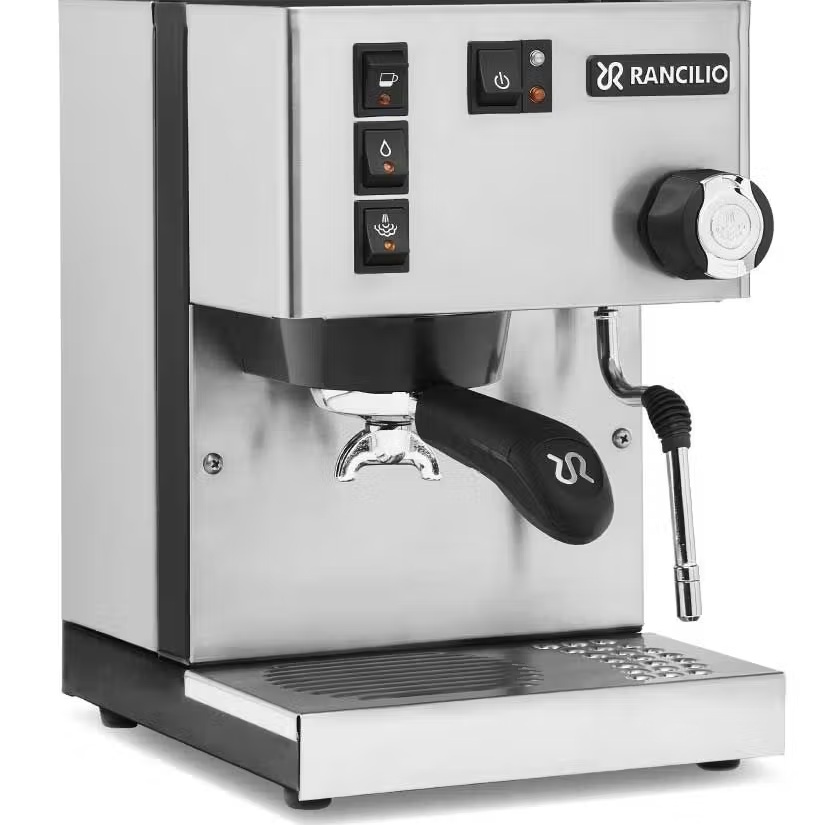

The Rancilio Silvia has been in production since the late 1990s. In a category where machines are replaced every few years, that’s close to unheard of — and it’s the single most useful fact about it.
“Miss Silvia” became the default recommendation for people getting serious about home espresso, and she’s held that position for over two decades. There is a genuine community around this machine, a deep well of documentation, and an aftermarket that exists because so many people own one.
She also has real, well-known limitations that a product page won’t tell you about, and one of them will define your entire experience of owning her.
Here’s what you’re actually buying at $995.
Disclosure: This page contains affiliate links. If you buy through them we may earn a commission at no extra cost to you.
We have not tested this machine. This is a research-based buying guide, not a hands-on review. It draws on published specifications, the machine’s design, and its long-documented reputation, but we haven’t lived with one. When we do, we’ll publish a full review to our testing standard and update this page. We’d rather tell you that than pretend otherwise.
Check current price at 1st in Coffee →
The short version
Buy the Silvia if: you want commercial-grade components at a home price, you’re willing to learn a manual workflow, you value repairability and longevity, and you’re mostly making one or two drinks at a time.
Don’t buy the Silvia if: you want convenience, you’re making four milk drinks back to back every morning, you don’t want to think about water temperature, or you don’t already have, or intend to buy a proper espresso grinder.
The single biggest caveat: the standard Silvia has no PID temperature control. This is not a minor spec omission. It shapes how you use the machine every single morning.
Specifications
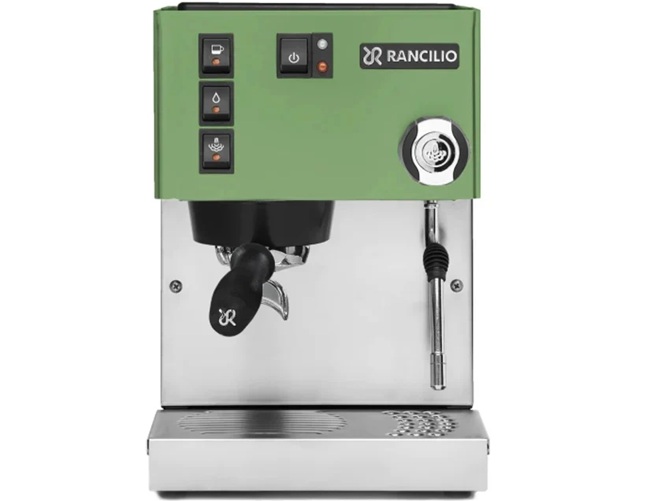
| Price | $995 (at time of writing) |
| Type | Single boiler, semi-automatic |
| Boiler | 12 oz (approx. 355ml) thermal-wrapped lead-free brass, stainless steel heating element |
| Group head | Chrome-plated brass, commercially derived |
| Portafilter | 58mm chrome-plated brass, commercial size |
| Baskets | Pressed stainless, single and double |
| Pump | Vibratory, 15 bar capable |
| Brew pressure | Adjustable internal OPV, factory set (~9 bar target) |
| Valve | 3-way solenoid |
| Water tank | 67 oz (approx. 2 litres), removable |
| Power | 950W, 120V |
| Dimensions | 13.75″ H × 9.25″ W × 12″ D (35 × 23.5 × 30.5 cm) |
| Weight | 30 lb (13.6 kg) |
| Warranty | 2 years parts and labor |
| Made in | Italy |
| Included | Portafilter with both baskets, metal tamper, measuring spoon, manual |
Note for readers outside the US: the machine listed here is the 120V North American version. The Silvia is sold in 220–240V markets including Australia, the UK and the EU, but you’ll need to buy it locally rather than through this listing, and free shipping applies only within the contiguous United States. Don’t buy a 120V machine expecting to run it on 240V mains.
What “V6” and “M” actually mean
The Silvia has been iterated steadily rather than redesigned. Version 6 with the M designation brings, per Rancilio:
- A thermal-wrapped lead-free brass boiler with an improved stainless steel heating element
- A redesigned steam valve
- A redesigned stainless steel drip tray
- Updated power switch and indicator lights (green for power, amber for the heating element)
What it does not bring: PID temperature control. That remains the domain of the Silvia E and the dual-boiler Silvia Pro X, both of which cost more.
If you see an older Silvia at a discount, the differences are incremental. The core machine, brass boiler, brass group, 58mm portafilter, single boiler, no PID. Has been essentially consistent for decades. That’s a compliment and a limitation at once.
What’s genuinely good about it
Commercial-grade components at a home price
This is the Silvia’s real argument, and it’s a strong one.
The 58mm chrome-plated brass portafilter is the same diameter used in most commercial machines. That matters practically: the aftermarket for 58mm accessories is enormous. Precision baskets, bottomless portafilters, distribution tools, tampers, all available, all cheap, all compatible. Machines with proprietary 53mm or 54mm portafilters lock you into a much smaller ecosystem.
The brass group head and brass boiler provide thermal mass. Metal holds heat, and heat stability is most of espresso. Cheaper machines use aluminium or thin components that swing wildly in temperature.
The 3-way solenoid valve is a genuinely commercial feature at this price. It releases brew pressure the moment you stop the shot, which means the puck comes out dry and the portafilter doesn’t spray you. Machines without it produce a soggy puck and the occasional “portafilter sneeze.”
Steam power
The Silvia’s steaming is well regarded and has been for twenty years. A 12 oz brass boiler dedicated entirely to steam, once switched over, produces genuinely powerful steam, enough to texture milk properly rather than just heating it and adding bubbles.
The wand is a plain chrome tube with no panarello or frothing aid. That’s deliberate: bare wands are what commercial machines use, they make real microfoam, and they wipe clean. They also require you to learn technique. There’s no shortcut.
It’s repairable, and parts exist
This is underrated and it’s why the Silvia endures.
Because the machine has barely changed in decades and has been sold in huge numbers, parts are available, documented and affordable. Gaskets, shower screens, thermostats, solenoids, pumps, all replaceable, all documented in community guides and video walkthroughs.
Most appliances at this price are disposable. A Silvia that’s fifteen years old and has had a few gaskets and a thermostat is a normal Silvia, not a dying one. Factor that into the cost comparison against a machine with sealed electronics and a five-year practical life.
Build
30 lb (13.6 kg) of steel frame and stainless housing. It doesn’t slide around the counter when you lock in a portafilter, which cheaper machines do. It’s also 13.75 inches tall. Check your cabinet clearance before ordering, because filling the top-loading tank requires headroom above that.
The three things that will frustrate you
An honest guide has to cover the parts the product page doesn’t.
1. No PID — you will have to temperature surf
This is the big one.
Without a PID controller, the Silvia’s boiler is governed by a mechanical thermostat, which switches the heating element on and off within a temperature band rather than holding a precise setpoint. The boiler temperature therefore cycles up and down continuously.
Pull a shot at the top of that cycle and your water is too hot, bitter, harsh espresso. Pull at the bottom and it’s too cool sour and thin. The temperature difference across the cycle is enough to noticeably change your coffee.
Owners deal with this by temperature surfing: watching the heating element indicator light, and timing the shot to a specific point in the heating cycle. The commonly described routine is to wait for the light to go out, flush a small amount of water through the group, wait a set number of seconds, then pull.
Is it workable? Yes. Thousands of people have made excellent espresso this way for over twenty years, and there’s extensive documentation on the technique.
Is it annoying? Also yes, particularly before coffee, which is when you’ll be doing it.
Your options:
- Learn to surf. It’s free, and it becomes routine.
- Fit an aftermarket PID kit. A well-established modification with a substantial community around it. Expect to add meaningful cost, and note it will likely affect your warranty, check before you drill anything.
- Buy the Silvia E or Pro X instead, which include PID from the factory at a higher price.
If the idea of managing water temperature by watching a light sounds tedious rather than charming, be honest with yourself now. This is the machine’s defining characteristic.
2. Single boiler means waiting
One boiler serves both brewing and steaming, at different temperatures. You cannot do both at once.
The practical sequence: pull your shot, flip the steam switch, wait for the boiler to climb to steam temperature, steam your milk, then. If you want another shot, wait considerably longer for it to cool back down to brew temperature, usually by running water through until it drops.
For one or two drinks, this is fine. For a household making four milk drinks on a weekday morning, it’s genuinely slow, and it’s the most common reason people outgrow a Silvia.
If you regularly make several milk-based drinks in a row, look at a heat exchanger or dual boiler machine and accept a considerably higher price.
3. The stock baskets are the weak link
The Silvia ships with pressed stainless steel baskets. Pressed baskets have less consistent hole size and distribution than precision-machined ones, which promotes uneven extraction and channelling.
This is a well-known upgrade path. A precision 58mm basket is an inexpensive purchase relative to the machine and is widely considered one of the highest-value improvements you can make. The commercial portafilter size means you have plenty of options.
Similarly, the included tamper is a giveaway-grade accessory. A properly fitted 58mm tamper is a worthwhile early purchase.
The thing nobody tells you: the grinder matters more

If you’re spending $995 on this machine, please read this part.
A Silvia with a bad grinder makes bad espresso. A modest espresso machine with an excellent grinder makes better coffee than an excellent machine with a modest grinder. This isn’t a marginal effect grind quality and consistency are the dominant variables in espresso.
Espresso demands a grinder that can adjust in very fine increments around a specific point, and produce a consistent particle size. Most general-purpose burr grinders, including good ones for filter coffee. Simply cannot do this well. Blade grinders are not an option at all.
Budget accordingly. A realistic espresso grinder starts at a meaningful fraction of the machine’s price, and plenty of experienced people will tell you to spend as much on the grinder as on the machine, if not more.
The Rancilio Rocky ($440) is the traditional companion and the pairing the “Silvia and Rocky” guides refer to. It’s a durable, well-built grinder though it’s an older design, and its stepped adjustment is a real limitation for espresso, where you often want to move between two steps. Worth comparing against modern stepless grinders in the same price range before committing.
Realistic total budget for a working setup:
| Item | Approximate |
|---|---|
| Rancilio Silvia M V6 | $995 |
| A capable espresso grinder | $400–700+ |
| Precision basket | $25–40 |
| Proper 58mm tamper | $30–80 |
| Scale with timer | $25–60 |
| Knock box, cleaning tablets, brush | $40–60 |
| Realistic total | $1,500–1,900+ |
If that number is a problem, buy less machine and a better grinder rather than the reverse.
Who should buy something else
If you want convenience: a super-automatic or a machine with automated milk will suit you far better. The Silvia is a manual instrument.
If you make four or more milk drinks in a row: get a heat exchanger or dual boiler. The single-boiler wait will wear you down.
If you want PID without modifying anything: look at the Silvia E or Pro X, or at competitors that include PID and temperature readout at similar money. Several modern machines offer more features per dollar than the Silvia does, the Silvia’s argument is build and longevity, not spec sheet.
If this is your first-ever espresso machine and you’re not sure you’ll stick with it: consider starting cheaper, or buying a used Silvia. They hold value and there’s a healthy secondhand market which is itself evidence of the machine’s durability.
If you’re outside the US: buy the correct voltage version from a local retailer.
So is it worth it?
Here’s the honest framing.
On a pure spec sheet, the Silvia loses. For $995 in 2026 you can buy machines with PID, pressure gauges, digital readouts, pre-infusion and shot timers. The Silvia has a switch, a light, and a knob.
On build, repairability and longevity, it wins comfortably. Brass boiler, brass group, commercial portafilter, steel construction, available parts, and a twenty-five-year documentation trail. It’s a machine you fix rather than replace.
Which matters more depends entirely on what you want. If you want features, there’s better value elsewhere. If you want an instrument you’ll still be using in fifteen years, and you’re willing to learn its quirks, the Silvia’s reputation is earned rather than nostalgic.
The people who love their Silvia tend to be the people who wanted to learn espresso. The people who regret it tend to be the people who wanted good espresso quickly. Work out honestly which one you are.
Check current price and availability at 1st in Coffee →
1st in Coffee lists a 2-year warranty, a 30-day satisfaction guarantee and free shipping within the contiguous US on this machine. Verify current terms at checkout.
Frequently asked questions
Does the Rancilio Silvia M V6 have a PID? No. The standard Silvia uses mechanical thermostats and requires temperature surfing. PID is available factory-fitted on the Silvia E and Pro X, or via aftermarket kits which may affect your warranty.
What is temperature surfing? Timing your shot to a specific point in the boiler’s heating cycle, using the heating element indicator light as a guide, to get consistent brew temperature without a PID.
Can the Silvia make two milk drinks in a row? Yes, but with waiting. The single boiler must switch between brew and steam temperatures, and cooling back down for a second shot takes noticeably longer than heating up for steam.
Is the Rancilio Rocky the right grinder for it? It’s the traditional pairing and a durable grinder, but it’s an older design with stepped adjustment, which is limiting for espresso. Compare it against modern stepless grinders at similar money before deciding.
What size portafilter does the Silvia use? 58mm, the commercial standard, which gives you access to a very large accessory aftermarket.
Is the Silvia good for beginners? It’s a good machine to learn on, not a good machine to avoid learning on. It rewards technique and offers no automation. If you want espresso without a learning curve, buy something else.
How long does a Rancilio Silvia last? Longevity is one of its main selling points parts are available and documented, and well-maintained machines are commonly reported to run for many years. We haven’t tested this ourselves and can’t verify durability claims first-hand.
What accessories should I buy first? A precision 58mm basket and a proper tamper. Both are inexpensive relative to the machine and both meaningfully improve results.
Does it need a water softener? Scale is the main killer of espresso machines. Use filtered or appropriately treated water and descale per the manual. In a hard water area this matters a great deal.
